The Rehearsal Layer
Imagine coming to a fork in the road. In life you choose one path and go down it. But what if you could go down every single pathway, then come back to the beginning with the knowledge of what lies along each of them, and choose the best one? What if we also asked why you chose that pathway, and why the others weren't the ones you chose? Now you have knowledge of the path you've taken, plus all the paths you didn't. This is the rehearsal layer we've built in: any decision can have a multitude of pathways, and learnings from all of them.
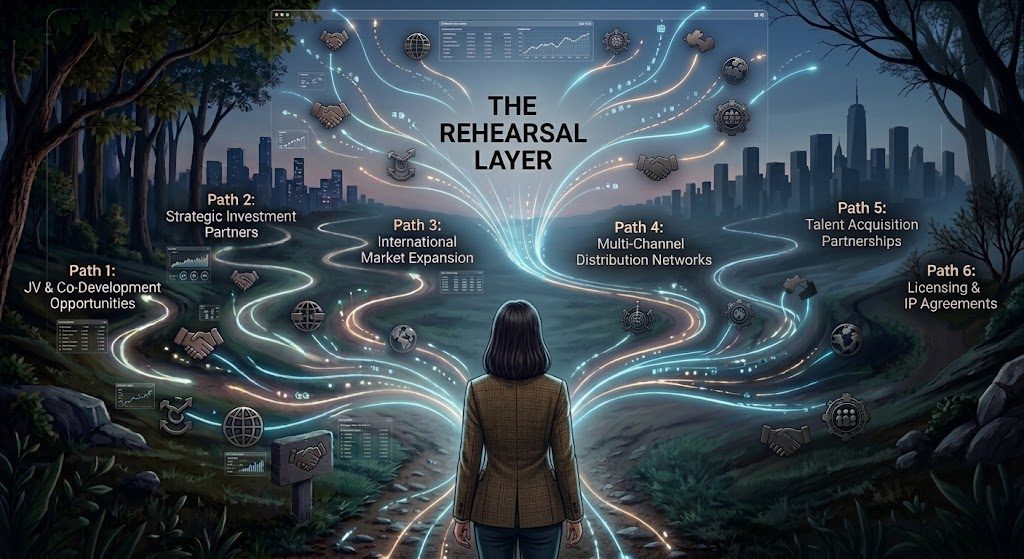
- The Problem: Organisations make decisions, commit to them, then wait months to evaluate outcomes. This slow feedback loop creates bias, fear of risk, and minimal learning — a company making one major decision yearly collects only ten data points per decade.
- The Solution: A rehearsal layer embedded in the decision process that simulates multiple pathways using adversarial panels, parameter sweeps, and independent bake-offs — before committing to reality.
- The Core Mechanisms: Engineer independence in simulated panels; maintain calibration through prediction logging; surface remarkable insights through a "membrane" that captures human judgement.
- The Compounding Advantage: Every rehearsal's reasoning, assumptions, and human rulings are retained and feed the next decision. Your tenth decision is sharper and cheaper than your first.
- The Data Sovereignty Angle: Unlike cloud AI vendors, this rehearsal layer keeps your knowledge yours. The reasoning, memory, and learning stay your asset. You own the loop.
Most organisations learn about a decision months after making it, and only about the path they took. By then the cost is sunk. A rehearsal layer moves that learning to before you commit, while it is still cheap.
And the learning stays yours. Every ruling your people make in rehearsal is captured and feeds the next one. Your tenth decision is sharper than your first, not because you hired better people, but because the process compounds.
01 · One observation per decision
The issue we face today is that an organisation can make a decision, commit to it, and then have to wait months before evaluating it, before the post-mortem that tells it whether or not it took the optimal path. And that has significant drawbacks. There are cognitive biases at work; people judge with the benefit of hindsight; post-mortems can create an environment of fear, so calculated risks are no longer taken. An organisation that makes one market-defining decision a year collects ten data points a decade.
What we really want is to understand, and to gather knowledge and learning. And if we gather that not just on the path taken but on the paths that could have been taken, we have so much more opportunity to gather compounding knowledge and learning. You can model a different choice against last quarter's numbers any time you like. What you can't do is rerun the actual quarter and watch the other choice play out.
What you can't do is rerun the actual quarter and watch the other choice play out.
02 · Rehearsal multiplies the evidence
The rehearsal layer solves that problem. Today we only get to review the decision we made. Simulating decision pathways lets us run against multiple assumptions and scenarios, and test them using various instruments. Panels of simulated participants, each with defined characteristics, objectives and beliefs, standing in for the people who aren't in the room: boards, regulators, readers, buyers, the market itself. Adversarial verification, whose only job is to break a conclusion: to test it, to make sure we've thought about how people might break that decision. Parameter sweeps, which show which assumption is actually carrying the answer. And finally, bake-offs between independently built answers, which tell you whether a conclusion is a fact about the world or an artefact of the method that produced it.
Throughout this entire process, humans are in the loop. Where decisions are being made, or could be made, they can be validated or challenged by a human, ensuring we are learning about the decisions we're making. Ultimately we want every decision to land as close as possible to where the organisation expected it to.
03 · The obvious objection
The first and most obvious objection is always the simulated panels. Aren't they just consensus machines? The naive answer is yes, and the research tends to agree. Models are trained towards a typical answer, so as time goes by they will converge on the same answers. And simulated panellists who share a base model will end up achieving absolutely none of the objectives we set out to deliver.
So what we need to do is engineer independence. We do this by enforcing stances, beliefs and commitments on every simulated participant, and we reapply them throughout the process, because, believe it or not, agents cave to peer pressure if you merely tell them to hold a view. Our panels use adversarial composition and are heavy on challengers, so when we rerun the same question with different casts, the finding is what survives.
Throughout this process, we also look for remarkable insights. We surface those notable snippets to the appropriate persons, who can comment on them, and we learn from those comments.
The brief that sets off this whole process matters as much as the panel you are forming. If you write it to reach a particular conclusion you have in mind, that conclusion will be reached through almost any panel. So the brief has to be thoroughly audited.
There's a number of studies that validate our thinking. One in particular was a Stanford blind study where machine ideas beat researchers' ideas on novelty, but didn't beat them on feasibility. Which is validating, because this is exactly where we see the humans in the loop coming in, in our architecture. We're focused on delivering structured disagreement. Because ultimately every instrument can be gamed. The safeguard is that we test things against each other, adversarially, and openly publish what breaks.
04 · Calibration keeps it honest
I'm sure you've experienced the sycophancy of the large language models. As Plutarch wrote in about 100 AD, "the flatterer's object is to please in everything he does, whereas a true friend always does what is right." Simulations are a product of large language models, so they can flatter. A rehearsal that always says yes, or is never challenging, is worse than no rehearsal at all, because it gives the person or the team doing the rehearsing an unfounded confidence ahead of a live decision.
A rehearsal that always says yes, or is never challenging, is worse than no rehearsal at all.
So we ensure that everything is built upon a calibration spine. Predictions are logged and checked against what actually happened in reality. Drift is measured and corrected.
We recently engaged with an investment bank. Across the research runs we've published, our own verification has refused four of nine. All four still went to the bank, with the refusals attached and the corrections that were made, so that they could see our reasoning, and make decisions aware of our workings and our refusals. Contextually better decisions, because nothing was hidden from them.
Ultimately, we want to engineer the crisis in a simulation, so you never hold it in reality.
We think so too, and here's why. A refusal is the most credible sentence a verification layer can produce. When our own verification refused four of nine runs for an investment bank, all four still went to the client with the refusals attached, and the decisions were better for it, because nothing was hidden.
We see it differently, though we understand the instinct. Withholding a refusal protects the confidence of the room for exactly as long as reality takes to test the decision. We publish ours because a refusal attached to a recommendation is what lets a board weigh it properly, and because a layer that only reports its successes is not one you can calibrate against.
That's fair, the conditions matter. Where we'd agree: a refusal should carry its reasoning and the corrections made, never a bare verdict, and some belong inside the room rather than in the public record. Where we'd part ways: whatever the audience, the decision-maker should always see it. That's the line we hold.
05 · What rehearsal cannot know
Rehearsals run on the record: the public record, and the institution's own corpus. What the record can't know is what a shop assistant gleaned on his way to work on a Tuesday, and we do not pretend we can. We try to mitigate this by ensuring that when we think we've discovered something remarkable, we escalate it to the appropriate people to review, because in doing that we may well stimulate ideas.
There are some things that we can't solve for. Things like internal politics and influence. And tacit knowledge (don't ask Hattie to be creative if Spurs lost at the weekend, so best not to ask her at all).
We try our best by introducing a rehearsal membrane. When a rehearsal surfaces a notable objection or insight, it's pushed through the membrane to the relevant person, who then rules on it. That contribution is placed on the record and becomes an attribution that is available for every run after it. If we do that hundreds of times, the knowledge store fills with harvestable insights: with the very knowledge it was missing when it started. The trick is ensuring that people care enough, that the effort is rewarding and never routine, because the moment it becomes a reflex, the human has to all intents and purposes left the loop.
We have limitations, two in particular. Obviously, we can only capture what we promote up as comment-worthy, so whatever hasn't been challenged, or raised as possibly challenge-worthy, stays outside. We also need to ensure that the right knowledge is being pulled into the decision process: whose knowledge gets pulled in is a design decision, not something an organisation chart can decide.
The final piece, and the one we are working towards solving, is how you audit a decision not to act. Because doing nothing produces no outcomes or paths to score. We absolutely log it. But we can't grade it yet...yet!
The claim isn't that we can predict what audiences think and might do with panels. What we do is question which decision survives rehearsal. And those decisions that survive fail less often. Calibration is how we know.
06 · Memory makes it compound
Every rehearsal we run is retained. With them, the reasoning behind them, the rejection and assumption attributions. Just holding that is an archive, which is OK, but we want it to be much more useful. We want these runs to feed reinforcing loops: each run should add to the platform's knowledge.
The key to success is ensuring what deserves attention gets surfaced to the people who rule on it, and what they do with it. Do they dismiss it, and why? Do they accept it, and what are the consequences? This ensures the next rehearsal starts from a learnt position. The advantage is that people are in the process, not reviewers at the end. This gives us access to hundreds of judgements a year, instead of just a handful of post-mortem anecdotes. The reasoning is captured in the moment, accruing that knowledge to the institution rather than leaving it with a single person. A tenth decision will be sharper and cheaper than the first, and not because anyone worked harder, but because of our learnings along the way.
There are two things that organisations lose: the memory of restraint (what didn't we do, and why?) and disagreement records (what was argued, what was the contention, what was the debate, and which rationale won?). If all of that is captured during the process, you don't just have a decision log; you have more: a disagreement log, which tells you about the thinking that went into those decisions.
It all comes back to the fact that committed decisions only give you one path. Rehearsing gives you a lineage across every future examined. Reality gives you one path. Our rehearsal layer gives you the map you were standing on when you chose it.
There was a map illustrating what was known vs unknown by Columbus posted on X. Which I thought was a good illustration of what we try to provide. We look to give you map 2 as you consider your voyage.


x.com/Mcuquerella/status/2094455318319169734
We think so too, and here's why. Compounding doesn't need better people; it needs the rulings people already make to be captured in the moment rather than reconstructed in a post-mortem. Once the membrane is in place, every rehearsal starts from a learnt position, and the tenth decision is sharper than the first.
We hear this often, and we don't dismiss it. Documenting the roads not taken is exactly the thing organisations drop first. Our answer is that it can't rest on discipline: the layer has to be built into the flow between intent and commitment, so capture is a by-product of deciding rather than an extra task. If it depends on people remembering, you're right, it won't compound.
That's the honest answer, and it's the one enterprises give us. Whether it compounds turns on four questions: how the roads not taken get captured, how fidelity is ensured, where the notability thresholds sit, and how a surprise is caught. None of those is technology. Design them in and it compounds; bolt them on and it won't.
07 · And the loop is yours
One big argument in AI right now is who ends up owning what your company learns. Satya Nadella has called it the Reverse Information Paradox. The old problem for people selling knowledge was that to sell it, you have to show it, and once you've shown it, it loses its value. With AI, that flips, because the person using the AI is the one who is giving something up. As a user of AI, I impart my knowledge, and the AI consumes it; the deal we make is that if I give, I get better results. So ultimately, I end up paying for the AI twice: once monetarily, and then again by gifting the AI vendors my know-how. The vendors want me to impart as much knowledge into the system as possible; as I keep on correcting, I'm fixing their wrong answers, and every time I fix a wrong answer, the machine is contextually becoming better and learning more about my business.
Palantir's point is that companies already have decision systems they suggest that you should own that record, but it's severely limited, it's only the record of action. A single pathway.
Pignataro, the ION founder, says in his essay The Wrong Apocalypse that the real value of knowledge work isn't actually the thinking itself; it's how everything gets pulled together, and how the decisions are coordinated. And ultimately, anyone using the frontier models is teaching those models the tacit knowledge of their industry and company.
I think they're all right. But the thing they're not allowing for, which we do, is that they assume only one path is being taken. We allow a multitude of paths to be taken, so we can examine a multitude of paths and understand the decision process around all of them.
And if you think about it: if, as people are saying, the corrections we make are the most valuable thing that leaks out of a company, that they are its unique IP, then the rulings our people make during rehearsals, pure judgement captured in the moment, are probably the most concentrated version of that there is. Which makes the rehearsal layer we're building hugely valuable, and the last operation you should ever run on someone else's learning loop.
The last operation you should ever run on someone else's learning loop.
So we think we have two answers, really, built into how we work. The first is that we allow people to explore pathways and futures without telling anyone. If you go and ask an outside person a question, you're already beginning to leak it. But if you ask it within your walls, you can test the whole idea and nobody knows what you're looking at. And the second is that we have built this to ensure we are not reliant on one single AI model. That's by design. The memory and the learning stay the client's asset. We run the loop. We never keep the data. When we leave, the loop stays.
08 · A layer, not a workshop
Decision rehearsal isn't new. War-gaming has been around for ages. But it's a point-in-time event. People come together for two or so days, you gather real insights, then the room empties and the learning walks out with it.
Every decision has two moments: the moment you intend to do something and then the moment you commit to doing it. There's a gap between those two positions, and that's where our rehearsal layer lives. Between the intent to do something and the commitment to do it.
Think about it like software. No code ever goes through to production without passing test. Nobody schedules a testing workshop; the release process just flows through test. Just as decisions should flow through the rehearsal layer.
When we've gone out to enterprises to talk about the layer, we assumed it would be a bone of contention. But when we put the question to people around consequential decisions, they don't debate the value. What they immediately jump to is how to ensure success, and how the compounding can be ensured. The same four questions kept coming up. How do we ensure that people capture and integrate the roads not taken, when documenting what wasn't done is so easily dropped? How do you ensure the fidelity of the rehearsals and the integrity of their outcomes? How do you manage notability thresholds: the agreed points where a rehearsal result flips the default from proceed to re-evaluate? And how do you capture a surprise, when a rehearsal produces something, the organisation really didn't see coming?
None of this is technology and it's why the layer has to be built in rather than bolted on when the stakes are so high.
Reality runs once. So when it does, you've already been there.
BRING THE DECISION YOU NEED TO GET RIGHT →Before you go
How informative was this article?
What do you want more of?
Where do we have this wrong?
Challenge our thinking, tell us what we have wrong. We really appreciate the feedback.
References
- Satya Nadella, "The Reverse Information Paradox", 12 July 2026
- Palantir, "Protect Your Sovereignty", 2026
- Andrea Pignataro, The Wrong Apocalypse, ION Analytics, 15 February 2026
- Zhang et al., Verbalized Sampling · typicality bias and mode collapse under preference training
- The Artificial Hivemind, NeurIPS 2025 · open-ended homogeneity across models
- Algorithmic monoculture · shared base models fail together
- Si, Yang & Hashimoto, Persona Inconstancy in Multi-Agent Collaboration · stance drift under peer pressure
- Stanford, The Virtual Lab, 2025
- Si, Yang & Hashimoto, Can LLMs Generate Novel Research Ideas? · blind review by 79 experts
- Mitchell, Ghosh & Passi, AI Agents Push Humans Out of the Loop, 2026 · approval fatigue and skill atrophy when human oversight becomes routine
- x.com/Mcuquerella/status/2094455318319169734 · the Columbus known/unknown maps referenced in §06